Wednesday, October 28, 2015

#6 - The Hero and the Crown

The Hero and the Crown (Damar, #1)

The Hero and the Crown
Robin McKinley
1985 Newbery Medal Winner
Fantasy

My introduction to this book was in high school.  I was in our school library with friends and my friend saw this book and told me that I had to read it.  So I picked it up....and I couldn't put it down. 

It was also my introduction to Robin McKinley, who I found out is known for her adaptations of fairy tales.  Her first novel was Beauty, an adaptation of "Beauty and the Beast" (which she adapted yet again with Rose Daughter).  The Hero and the Crown and The Blue Sword (which is a Newbery Honor book) are not fairy tale adaptations but are high fantasy novels which take place in the imaginary land of Damar.  Hero is technically the prequel to Blue Sword, although the two can technically read in either order. 

The main character in the book is Aerin, the daughter of the king and queen.  Most of the royal family members have some form of magical powers (called "The Gift"), except for Aerin, who is teased by her other cousins, especially Galanna.  To prove that she is of royal blood, she eats a bunch of surka leaves which leaves her bedridden for quite a long time but does not kill her.  While she recovers, she forms a bond with her father's old lame warhorse, Talat and works to find the secret lost recipe of kenet, a substance that makes things fire proof.  After she recovers, she decides to go out and slay dragons.

One of the best features of McKinley's writing is her descriptive writing.  It brings the book to life.  Aerin is a very amusing and multi-dimensional character who grows immensely throughout the novel.

Saturday, October 24, 2015

#7 - Where the Mountain Meets the Moon

Where the Mountain Meets the Moon

Where the Mountain Meets the Moon
Grace Lin
2010 Newbery Honor Book
Folk/Fantasy

When I started the task of reading the Newbery list, this was one of the first books I picked up from the library.  I was enchanted.  I couldn't put it down. 

Grace Lin doesn't so much tell the story as weave the story.  The main story is that is Minli, a girl who lives next to Fruitless Mountain and hopes to change her family's poor fortune by seeking the Old Man of the Moon.  The main story contains "stories within a story" that eventually connect back to the main story.  Lin makes it easy to tell when we are reading one of these by not only putting a clear title for each story but also changing the font so it is easy for the reader to see when the story ends and the main plot picks back up.  One of the best features of this book is that there is color all over the pages.  She adds small splashes of color throughout with some additional full color illustrated pages which are absolutely gorgeous. 

At the end of the book, Lin tells the story of how she ignored her Taiwanese heritage until one day she picked up a book of Chinese fairy tales that her mother had put on her bookshelf and rediscovered her culture.  She traveled to China and the surrounding areas which gave her inspiration for many of the illustrations and places in the book.  Lin has another series of books based on her life as a Taiwanese American girl (Year of the Dog, Year of the Rat and Dumpling Days) and she has written a follow up book to this book in a similar style called Starry River of the Sky

I feel this book was a much better book than the medal winner for 2010, When You Reach Me.  Personally, I think it was robbed.

Friday, October 23, 2015

Newbery 2000

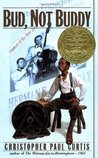
Bud, Not Buddy
Bud, Not Buddy
Author: Christopher Paul Curtis
Genre: Historical Fiction
Plot: Bud runs away from his foster family to try to find his father.
Verdict: Great story
My rating: 4 stars

Getting Near to Baby
Author: Audrey Couloumbus
Genre: Realistic Fiction
Plot: Two sisters contemplate the death of their baby sister on their aunt's roof.
Verdict: Quite sad
My rating: 3 stars

Our Only May Amelia
Our Only May Amelia
Author: Jennifer L Holm
Plot: May Amelia is a tom boy in a family with all brothers
Verdict: Use quotation marks, Jennifer L. Holm!
My rating: 1 star

26 Fairmount Avenue (26 Fairmount Avenue, #1)
26 Fairmount Avenue
Author: Tomie dePaola
Plot: Tomie's parents are building a new house.
Verdict: Humorous biography
My rating: 5 stars

I was pleasantly surprised by Bud, Not Buddy.  The character of Bud is a well developed and interesting as he runs away from his abusive foster family during the Great Depression in search of his father.  I loved the scene with the "fake family" and also the whole jazz band which Bud runs into at the end of the book.  Getting Near to Baby is a sad story told in flashbacks about two sisters who have lost their baby sister.  I could not stand Our Only May Amelia because all of the dialogue omits quotation marks, which drove me crazy.  I may try the audio version later but I wasn't terribly intrigued by the book.

Last, but not least, we have Tomie dePaola's autobiographical novella 26 Fairmount Avenue.  I was introduced to this book in my undergrad student teaching.  I have read all eight books in this series.  Tomie was definitely a precocious child.  I think my favorite story was when he went to see Snow White and the Seven Dwarves.   It is a very short read with illustrations so it is a great read for children and a good beginner chapter book.

Wednesday, October 21, 2015

#8 - Flora and Ulysses

Flora and Ulysses: The Illuminated Adventures

Flora and Ulysses: The Illuminated Adventures
Kate DiCamillo
2014 Newbery Medal Winner
Animal Fantasy

I am a huge fan of Kate DiCamillo.

I believe my first book of hers was The Tale of Despereaux (which is the 2004 Newbery Medal Winner) which I randomly picked out of the book order because I thought the cover was cute.  Or it might have been Because of Winn-Dixie.  I'm not really sure which.  My undergrad reading professor happened to know her because our college was in Minnesota and DiCamillo lives around the Twin Cities.  This is an author who struggled to get published, who still has a shoebox of the rejection letters she received for her books.

I was extremely upset when The Miraculous Journey of Edward Tulane was passed over for any kind of Newbery recognition because it was just that awesome of a book.

Anyway, I was in Half Price Books with my husband in the spring of 2014 and I saw this book.  Since I love DiCamillo, I picked it up no questions asked.  That spring, I was also taking a graduate level reading class and when I went in for one of our extended Saturday sessions (yes, you may have to give up your Saturdays for grad school, such is life), I found out that the 2014 Newbery list was out and that the book that I had picked up on a whim was at the top of the list.  When I was done with class, I came home and devoured the book.

I know a lot of people have said negative things about this book because it's part graphic novel.  Some how graphic novels have received a bad rap and I'm not sure why.  Maybe it's because they're heavily illustrated.  Some of them are light on content, to be sure, however, there are many which take a large amount of background knowledge to fully understand (The Sandman by Neil Gaiman comes to mind).  I applaud the Newbery committee for not shunning this book just because it's illustrated.

The main character is Flora who lives with her mother and loves to read comic books.  Her neighbor, Tootie, has just been given a very powerful vacuum cleaner and has inadvertently sucked up a squirrel.  Flora resuscitates the squirrel which now appears to have superpowers despite having lost most of its fur.  The rest of the book explores Flora's relationship with her father and mother (who are divorced), Tootie's very strange and temporarily blinded grand-nephew William Spiver, Flora's father's truthsaying neighbor Dr. Meescham and the newly-Christened squirrel Ulysses who is on a quest to find his role as a squirrel with superpowers.

The plot is definitely eccentric but the characters have very real problems that they are dealing with.  You will want to break out your dictionary because DiCamillo does not shy away from using large vocabulary words that even adults may have not encountered.  The graphic novel portions of the book help to carry the plot along and are mostly used in action sequences where the reader could easily be bogged down with an overly long description of what is going on. The graphics actually fit in the context of the book because Flora is a comic book fanatic and because this is essence a superhero book starring a squirrel so it's not like they were just copied and pasted in for no reason. 

Tuesday, October 20, 2015

#9 - The Graveyard Book

The Graveyard Book


The Graveyard Book
Neil Gaiman
2009 Newbery Medal Winner
Fantasy

My first introduction to the writing of Neil Gaiman was with his extremely popular graphic novel series The Sandman.  This series is definitely not for children, but it is a great example of how Gaiman blends mythology and legend into his writing.

I remember seeing this book at Barnes and Noble with the gold Newbery Medal gleaming on the hardcovers and I was like "I can't believe it.  Neil Gaiman won the Newbery Medal."  This is not to say that Gaiman is a bad writer, but having read some of his adult literature and I was surprised that the Newbery committee would pick a known fantasy writer like him to win the medal.  While all genres are represented on the Newbery list, the majority of the books are realistic fiction (either contemporary or historical).

I couldn't afford a copy of the book at the time so I borrowed it from the library and loved it.  Somehow, I never ended up with my own copy, which I remedied a few months ago.  I started rereading it yesterday and for a moment, I wondered if it was really as good as I remembered.

The answer is yes.

The story opens with a murder.  The man Jack murders a family but somehow misses the youngest child which escapes his crib and wanders out of the house into the local historical graveyard.  The ghost of his murdered mother cries out to the other ghosts to protect him so he is given the "Protection of the Graveyard" and given the name Nobody Owens.

The rest of the book is a series of short stories about Nobody's (or Bod's) adventures growing up in the graveyard.  He is now allowed to leave as he would lose his protections.  This makes his education difficult.  He is cared for by Mr. and Mrs. Owens, who are ghosts, and Silas, who is a vampire (although it's not expressly stated but there are clues).  Gaiman says he was inspired by The Jungle Book, which is occasionally paralleled in this book.

Monday, October 19, 2015

#10 - The Witch of Blackbird Pond

The Witch of Blackbird Pond

The Witch of Blackbird Pond
Elizabeth George Speare
1959 Medal Winner
Historical Fiction

I originally read this book in late grade school (probably 5th, 6th or 7th grade).  I remember checking it out from our small school library.  I have no idea why I picked it.  I wasn't a huge fan of historical fiction.  I'm sure I had to pick out some book
The Witch of Blackbird Pond
The School had this version.
I liked it so much I eventually picked up my own paperback copy for my personal library. 

The book is set in Puritan Connecticut.  Kit, the main character, has traveled here from Barbados because her grandfather died and she was forced to sell off all his land and possessions.  Her only remaining family is her Aunt Rachel (her mother's sister) and her Uncle Matthew.  Kit does not fit in well in this new place with her lack of experience doing hard work and her fancy dresses.  She ends up running the Dame school with her crippled cousin Mercy and after an incident there, flees to the meadow where she meets the Widow Tupper.  Widow Tupper is an eccentric old woman and a Quaker.  The town thinks she's a witch. Therefore, it would be a good idea for Kit not to associate with her.

There are three male characters of note.  Nat is the son of the captain of the ship that ferried Kit to Connecticut.  William Ashby seems to have his eye on Kit.  John Holbrook is studying with the Dr. Rev. Bulkeley and seems to have his eye on Judith, Kit's older cousin.

Re-reading this book as a adult, I noticed more of the historical context than I probably noticed as a child.  I understand more of the Puritan culture and the political landscape surrounding the loyalists.  I recognized the poetry of Anne Bradstreet which I studied in high school.  The subplot with the charter is based on historical facts as well.  I recently subbed in an eighth grade class reading this book and I'm not sure the students understood the historical context (if they did, they either didn't pay attention, or played the fool, it's hard to tell when you are the sub).  I enjoyed re-reading this book.  The plot is still great, the characters are developed and the heroine is spunky.

As for Speare, she is one of the few authors to win the Newbery twice.  She also has one honor book as well.

Sunday, October 18, 2015

Historical Fiction

Historical fiction a is type of realistic fiction that is set in the past.  Historical fiction may be set at a specific time or during a general era of time.  Some authors choose to write fictionalized accounts of actual people from the past.  Many times, authors will write about their own life or one of their ancestors. 

Many older contemporary realistic fiction books have been re-categorized as historical fiction because of their age. 

Whatever the setting, it is important that the setting and characters be realistic and credible.  The best historical fiction has been thoroughly researched by the author.  Often, actual historical events and people will be woven into the fictional story.  Some authors choose to try to use authentic language, however, many will modify it because it is often difficult to read by modern readers.  If the books contain illustrations, these should be historically accurate as well.

- Information taken from Galda and Cullinan's Literature and the Child

Newbery books that are historical fiction:
  • One Came Home (Wisconsin - 1871) - Amy Timberlake (2014)
  • Paperboy (Memphis - 1959) - Vince Vawter (2014)
  • Dead End in Norvelt (Norvelt, Pennsylvania - 1960s) - Jack Gantos (2012)
  • Inside Out & Back Again (Saigon/U.S. - Vietnam War) - Thanhha Lai (2012)
  • Breaking Stalin's Nose (USSR - Cold War) - Eugene Yelchin (2012)
  • Moon Over Manifest (Manifest, KS - 1918/1936) - Clare Vanderpool (2011)
  • Turtle in Paradise (Key West - 1935) - Jennifer L. Holm (2011)
  • Heart of a Samurai (Imperial Japan - 1841) - Margi Preus (2011)
  • One Crazy Summer (Oakland, CA - 1968) - Rita Williams-Garcia (2011)
  • The Evolution of Calpurnia Tate (Fentress, Texas - 1899) - Jacqueline Kelly (2010)
  • The Mostly True Adventures of Homer P. Figg (Civil War) - Rodman Philbrick (2010)
  • Good Masters! Sweet Ladies! Voices from a Medieval Village (Europe - Middle Ages) - Laura Amy Schlitz (2008)
  • Elijah of Buxton (Buxton, Canada - mid-1800s) - Christopher Paul Curtis (2008)
  • The Wednesday Wars (Long Island, NY - 1967) - Gary D. Schmidt (2008)
  • Penny from Heaven (Brooklyn - 1953) - Jennifer L. Holm (2007)
  • Hattie Big Sky (Montana - 1917) - Kirby Larson (2007)
  • Kira-Kira (Georgia - 1950s) - Cynthia Kadohata (2005)
  • Al Capone Does My Shirts (Alcatraz Island - 1935) - Gennifer Choldenko (2005)
  • Lizzie Bright and the Buckminster Boy (Malaga Island, Maine - 1911) - Gary D. Schmidt (2005)
  • Crispin: The Cross of Lead (Europe - Middle Ages) - Avi (2003)
  • A Single Shard (Imperial Japan) - Linda Sue Park (2002)
  • A Year Down Yonder (rural Illinois - 1937) - Richard Peck (2001)
  • Bud, Not Buddy (Flint - Great Depression) - Christopher Paul Curtis (2000)
  • Our Only May Amelia (Washington - 1899) - Jennifer L. Holm (2000)
  • A Long Way from Chicago (rural Illinois - 1929-1942) - Richard Peck (1999)
  • Out of the Dust (Oklahoma - 1934-1935) - Karen Hesse (1998)
  • The Midwife's Apprentice (Europe - Middle Ages) - Karen Cushman (1996)
  • Catherine Called Birdy (Europe - Middle Ages) - Karen Cushman (1995)
  • Dragon's Gate (California - 1867) - Laurence Yep (1993)
  • The True Confessions of Charlotte Doyle (Atlantic Ocean - 19th century) - Avi (1991)
  • Number the Stars (Copenhagen - 1943) - Lois Lowry (1990)
  • Sarah, Plain and Tall (western U.S. - late 19th century) - Patricia MacLachlan (1986)
  • The Sign of the Beaver (North America - 18th century) - Elizabeth George Speare (1984)
  • Homesick: My Own Story (China - 1920s) - Jean Fritz (1983)
  • A Gathering of Days: A New England Girl's Journal, 1830-1832 (1830-1832 - New Hampshire) - Joan W. Blos (1980)
  • Roll of Thunder Hear My Cry (Mississippi - 1933) - Mildred D. Taylor (1977)
  • Sing Down the Moon (New Mexico - 1800s) - Scott O'Dell (1971)
  • Sounder (Deep South - 19th Century) - William H. Armstrong (1970)
  • The Black Pearl (Mexico) - Scott O'Dell (1968)
  • Up a Road Slowly (U.S. - mid 20th century) - Irene Hunt (1967)
  • Shadow of a Bull (Spain - mid 20th century) - Maia Wojciechowska (1965)
  • Across Five Aprils (Ohio - American Civil War) - Irene Hunt (1965)
  • Men of Athens (Ancient Greece) - Olivia Coolidge (1963)
  • The Bronze Bow (Judea - time of Christ) - Elizabeth George Speare (1962)
  • Island of the Blue Dolphins (Channel Islands - 1800s) - Scott O'Dell (1961)
  • The Witch of Blackbird Pond (Wethersfield, Connecticut - 1687) - Elizabeth George Speare (1959)
  • The Family Under the Bridge (Paris) - Natalie Savage Carlson (1959)
  • Rifles for Watie (Kansas - American Civil War) - Harold Keith (1958)
  • Miracles on Maple Hill (Edinboro, Pennsylvania - 1950s) - Virginia Sorensen (1957)
  • Courage of Sarah Noble (Connecticut - 18th century) - Alice Dalgliesh (1955)
  • King of the Wind (Arabia - 1700s) - Marguerite Henry (1949)
  • These Happy Golden Years (De Smet, South Dakota - 1882-1885) - Laura Ingalls Wilder (1944)
  • Rufus M. (Cranbury, Connecticut - World War I) - Eleanor Estes (1944)
  • The Middle Moffat (Cranbury, Connecticut - World War I) - Eleanor Estes (1944)
  • Little Town on the Prairie (De Smet, South Dakota - 1880-1881) - Laura Ingalls Wilder (1942)
  • Indian Captive: The Story of Mary Jemison () - Lois Lenski (1942)
  • Call it Courage (Pacific Islands) - Armstrong Sperry (1941)
  • The Long Winter (De Smet, South Dakota - 1881) - Laura Ingalls Wilder (1941)
  • By the Shores of Silver Lake  (De Smet, South Dakota - 1870s) - Laura Ingalls Wilder (1940)
  • On the Banks of Plum Creek (Plum Creek, Minnesota - 1870s) - Laura Ingalls Wilder (1938)
  • Caddie Woodlawn (Dunnville, Wisconsin - 1860s) - Carol Ryrie Brink (1936)
  • Day on Skates: The Story of a Dutch Picnic (Holland) - Hilda Von Stockum (1935)
  • Young Fu of the Upper Yangtze (China - 1920s) - Elizabeth Lewis (1933)
  • Calico Bush (Maine - Pioneer era) - Rachel Field (1932)